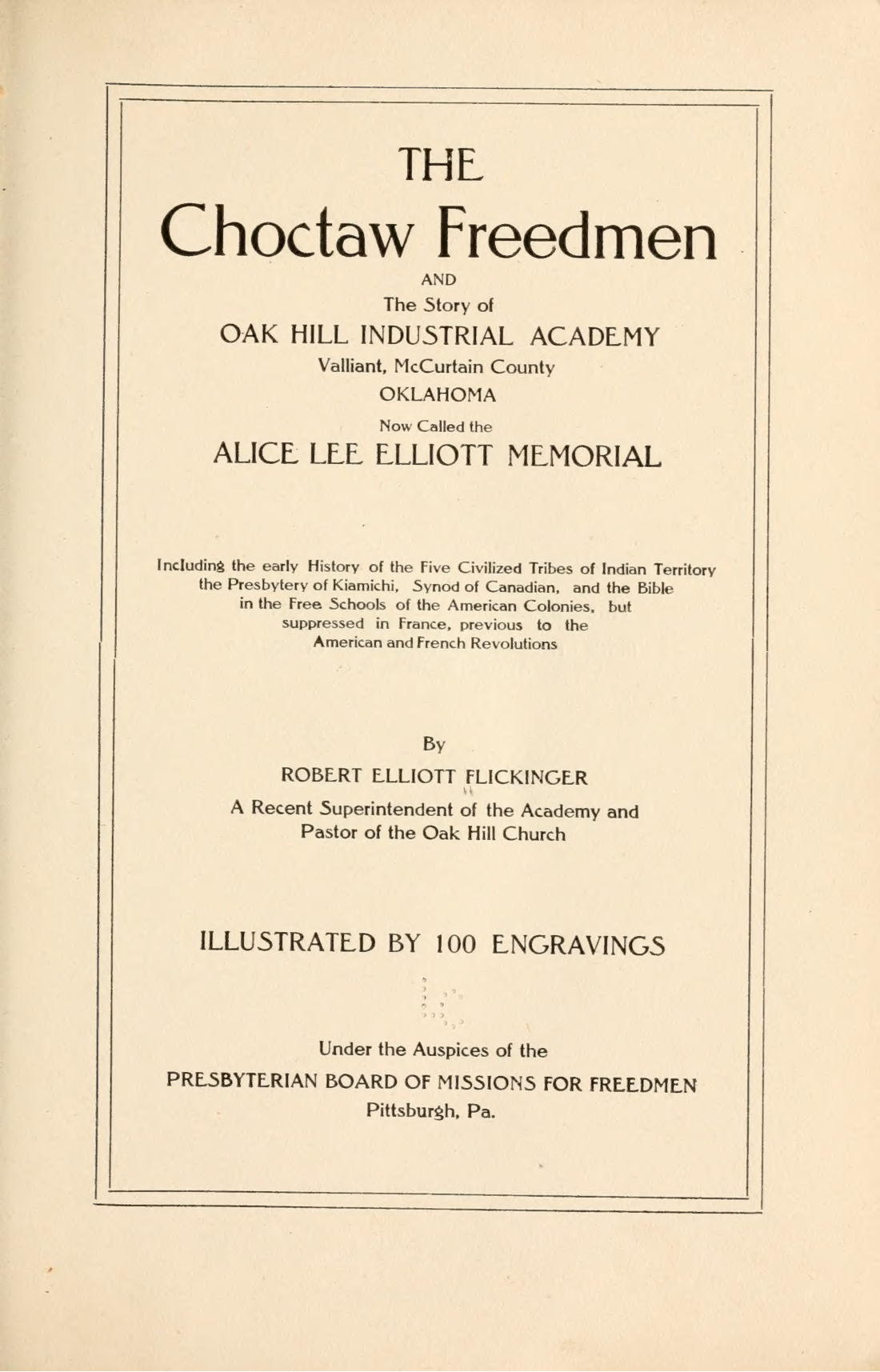
The Choctaw Freedmen and The Story of Oak Hill Industrial Academy
Robert Elliott Flickinger and Presbyterian Church in the U.S.A. Board of Missions for Freedmen · 1914 · 496 pages
Download it from your account as soon as you have paid, as often as you need.
Written by Robert Elliott Flickinger, a recent superintendent of the academy and pastor of the Oak Hill Church, this work was published in 1914 by the Presbyterian Board of Missions for Freedmen in Pittsburgh, Pennsylvania. The book documents the history of the Choctaw Freedmen and the Oak Hill Industrial Academy in Valliant, McCurtain County, Oklahoma, which was later renamed the Alice Lee Elliott Memorial.
The volume is divided into four main sections covering general facts about the Indian Territory and the American Negro, the history and operation of the Oak Hill Industrial Academy, the Presbytery and Synod, and the role of the Bible in public schools. It includes a list of portraits, a list of illustrations, historical accounts of the school's leadership, and an index.
Details
- Title
- The Choctaw Freedmen and The Story of Oak Hill Industrial Academy
- Full title
- The Choctaw freedmen and the story of Oak Hill industrial academy, Valliant, McCurtain County, Oklahoma, now called the Alice Lee Elliott memorial; including the early history of the Five civilized tribes of Indian Territory, the presbytery of Kiamichi, synod of Canadian, and the Bible in the free schools of the American colonies, but suppressed in France, previous to the American and French revolutions
- By
- By Robert Elliott Flickinger
- Publisher
- Presbyterian Board of Missions for Freedmen, Pittsburgh, Pa.
- Published
- 1914
- Kind of book
- County and town history
- Place
- McCurtain County, Oklahoma
- Pages in the PDF
- 496
- Format
- PDF with a searchable text layer
- Surnames found
- 253
- Scanned from the copy at
- The Library of Congress
Contents
- I. General Facts
- Introduction, List of Portraits
- I Indian Territory
- II Indian Schools and Churches
- III The Bible, An Important Factor in Civilization
- IV The American Negro
- V Problem of the Freedman
- VI Voices From the Black Belt
- VII Uplifting Influences
- VIII The Presbyterian Church
- IX The Freedmen's Board
- X Special Benefactors
- II. Oak Hill Industrial Academy
- XI Native Oak Hill School and Church
- XII Era of Eliza Hartford
- XIII Early Reminiscences
- XIV Early Times at Forest
- XV Era of Supt. James F. McBride
- XVI Era of Rev. Edward G. Haymaker
- XVII Buds of Promise
- XVIII Closed in 1904
- XIX Re-Opening and Organization
- XX Prospectus in 1912
- XXI Obligation and Pledges
- XXII Bible Study and Memory Work
- XXIII Decision Days
- XXIV The Self-Help Department
- XXV Industrial Education
- XXVI Permanent Improvements
- XXVII Elliott Hall
- XXVIII Unfavorable Circumstances
- XXIX Building the Temple
- XXX Success Maxims and Good Suggestions
- XXXI Rules and Wall Mottoes
- XXXII Savings and Investments
- XXXIII Normals and Chautauquas
- XXXIV Graces and Prayers
- XXXV Presbyterial Meetings and Picnics
- XXXVI Farmer's Institutes
- XXXVII The Apiary, Health Hints
- XXXVIII Oak Hill Aid Society
- XXXIX Tributes to Workers
- XL Closing Day, 1912
- III. The Presbytery and Synod
- XLI Presbytery of Kiamichi
- XLII Histories of Churches
- XLIII Parson Stewart
- XLIV Wiley Homer
- XLV Other Ministers and Elders
- XLVI Synod of Canadian
- IV. The Bible in the Public School
- XLVII The Public School
- XLVIII A Half Century of Bible Suppression in France
From page 85
The Presbyterian church takes a patriotic interest in our whole public school system, and believes that all the children should be trained in those that are under public direction, so that all the children and youth of the nation shall be a united, intelligent and patriotic body, fitted for good citizenship. At the same time it believes in special church institutions of higher learning, that shall be adapted to train our young people for intelligent leadership in the church, and enable them to become doubly useful in the home, social circle and in public life. Our christian academies and colleges are valuable institutions. These furnish to the church and the world the greatest number of ministers, missionaries, college presidents and christian statesmen. Parents everywhere, find these christian institutions furnish the best advantages, and that they are the safest and most economical. No institutions furnish higher or more profitable culture. They combine all that is best in real culture and education of the intelligent faculties, with a true religious conception of life.
Questions about this book
What was the original name of the Alice Lee Elliott Memorial?
The institution was originally known as the Oak Hill Industrial Academy, located in Valliant, McCurtain County, Oklahoma. It was established for the benefit of the Freedmen of the Choctaw Nation, Indian Territory, by the Presbyterian church in 1886.
Who was the first white teacher at Oak Hill Industrial Academy?
Miss Eliza Hartford became the first white teacher at Oak Hill Industrial Academy in 1886. The Presbyterian church had established the academy that year for the benefit of the Freedmen of the Choctaw Nation, Indian Territory.
What purpose did Elliott Hall serve in the school's history?
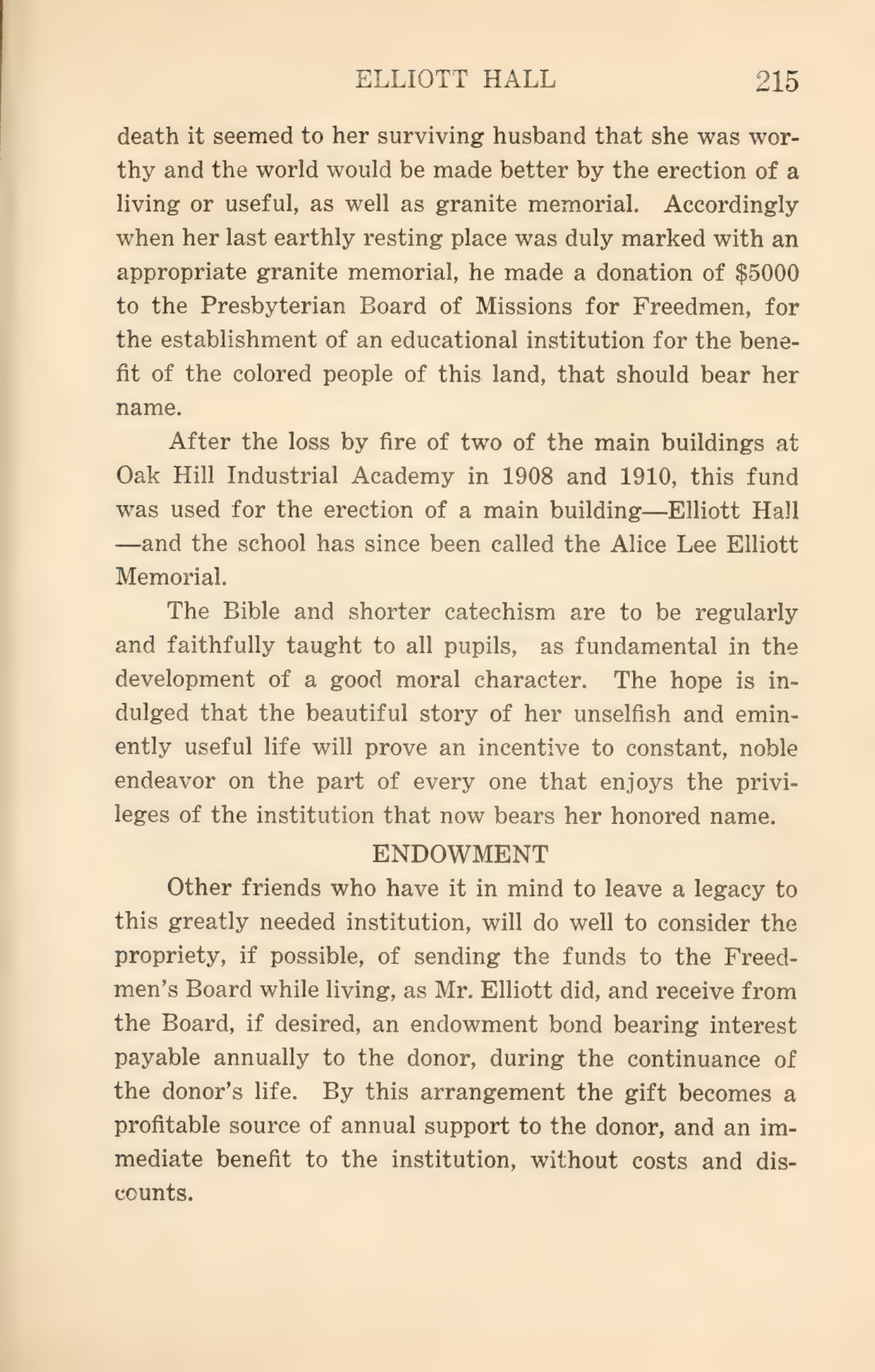
Elliott Hall was a main building erected in 1910 using a donation of 5,000 dollars from the surviving husband of Alice Lee Elliott. The building was dedicated in 1912, at which time the academy was renamed the Alice Lee Elliott Memorial.
Inside the book
Surnames in this book
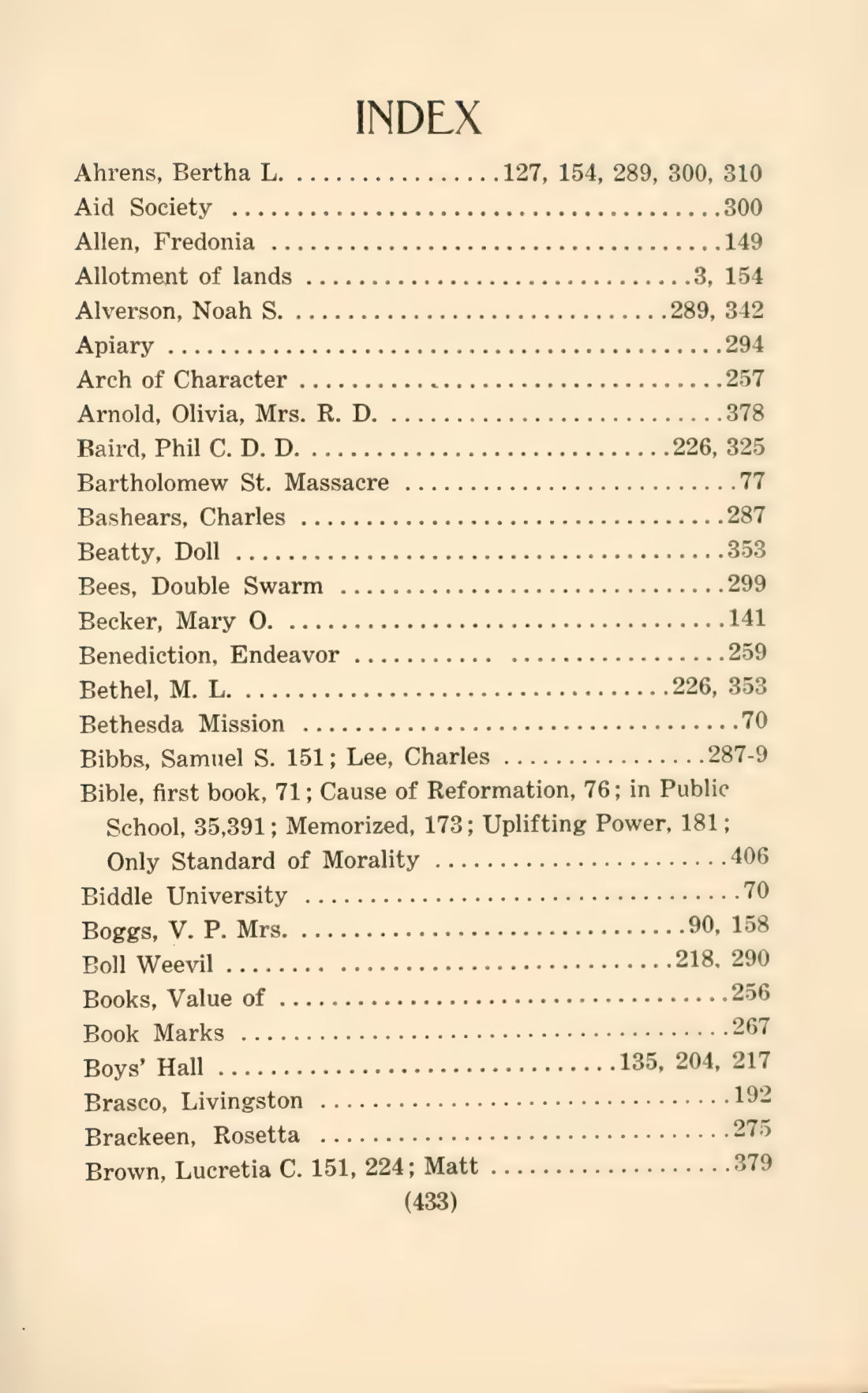
- Ahrens
- Alverson
- Baird
- Becker
- Bibbs
- Boggs
- Branch
- Bridges
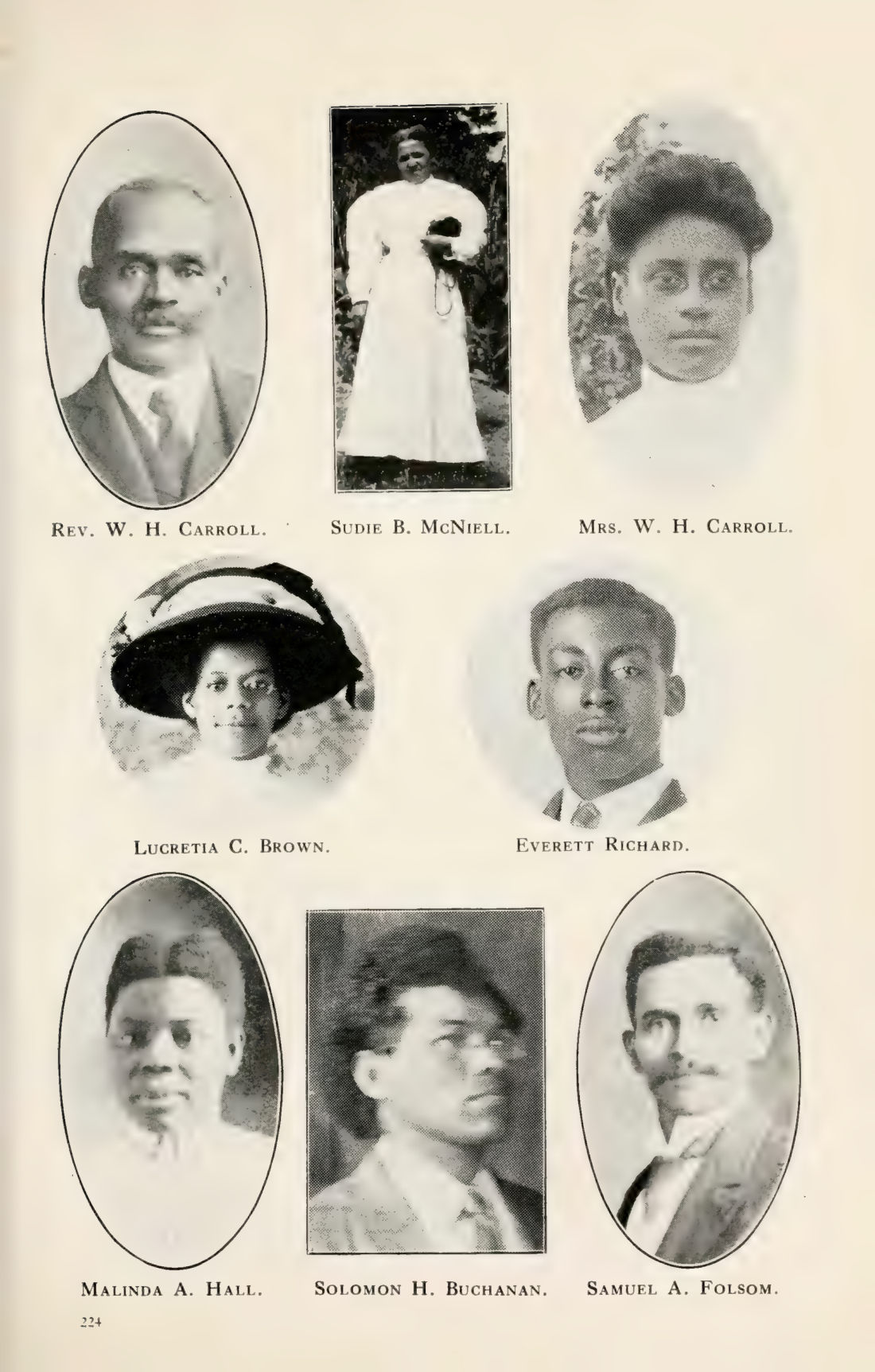
- Brown
- Buchanan
- Burris
- Butler
- Campbell
- Christ
- Claypool
- Colbert
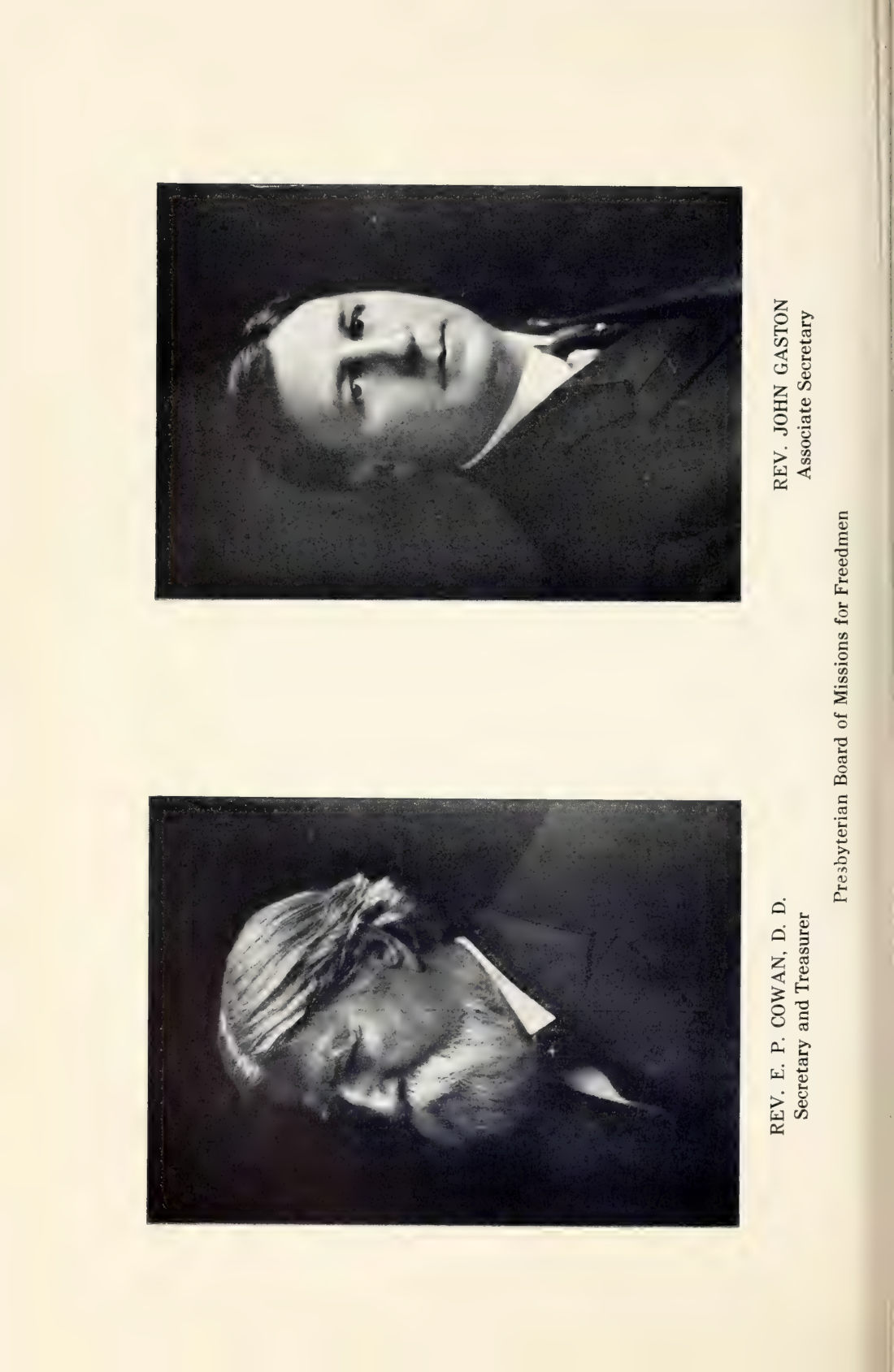
- Cowan
- Crabtree
- Crawford
- Crittenden
- Crowe
- Daly
- Donaldson
- Eaton
- Edwards
- Fisher
- Flickinger
- Flournoy
- Folsom
- Gladman
- Harris
- Haymaker
- Hebron
- Hollingsworth
- Holmes
- Homer
- Johnson
- Jones
- Kingsbury
- Knox
- Lewis
- Lord
- McBride
- Meadows
- Moore
- Murchison
- Ogburn
- Parson
- Peete
- Perkins
- Richards
- Shoals
- Sleeper
- Spain
- Starks
- Webster
- Weimer
- Wofford
- Wolcott
- Wright
Books for Oklahoma
 OklahomaIndian territory, descriptive, biographical and genealogical, Volume 11901 · 1,070 pages933 surnames$24.99
 OklahomaR.L1903 · 884 pages2,140 surnames$19.99
 AlabamaThe history of Butler County, Alabama1885 · 294 pages259 surnames$14.99
 AlabamaHistory of Conecuh County, Alabama1881 · 265 pages214 surnames$14.99
 ArkansasHistory, anniversary celebration and financial report of the work of the Phillips, Lee and Monroe County Missionary Baptist District Association1890 · 140 pages125 surnames$9.99
 ArkansasD1906 · 62 pages185 surnames$7.99
 ArkansasHistory of Scott County, Arkansas1922 · 88 pages392 surnames$7.99
 CaliforniaHistory of Alameda County, California1883 · 1,196 pages1,973 surnames$24.99